
Tier 1 – Foundational knowledge
Sections
Knowledge
You need to know:
- each victim and survivor carries a unique lived experience of child sexual abuse, as well as unique strengths and resilience
- respectful engagement with all victims and survivors will achieve the best outcomes
- the importance of being transparent about your role within the service and what you can offer the victim or survivor
- the importance of providing practical support for adults, young people and children to address current stressors and immediate needs (e.g. finances, housing or education) where appropriate
- the importance of services responding to victims and survivors in a timely manner.
Skills
You can:
- respond to victims and survivors in a caring manner, with kindness and compassion, and adopt a friendly and relaxed approach
- be directed by what the person is asking you for and what they think will be safe for them
- engage with the victim or survivor to identify what you and your service can and can’t do to help them
- identify who can assist you to increase the victim and survivor’s access to relevant and appropriate services
- offer information and support to help victims and survivors of all ages and their families, kin and supporters to access relevant services.
Tools to support you

Did you know?
Responding well to a victim or survivor can change their life outcomes
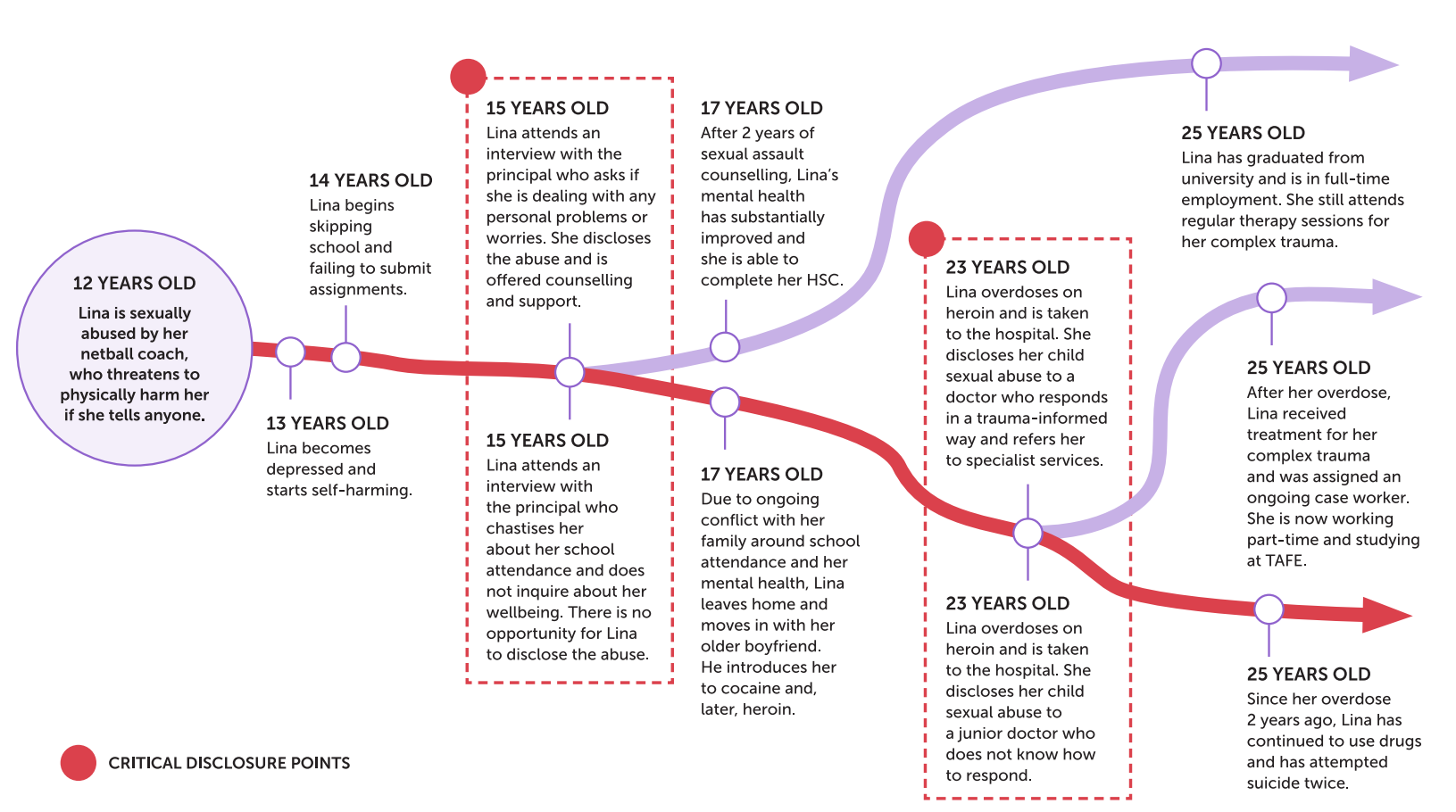
This graphic shows a pathway representing the diverging life course of a victim and survivor based on the response they receive to disclosure.
12 years old
Lina is sexually abused by her netball coach, who threatens to physically harm her if she tells anyone.
13 years old
Lina becomes depressed and starts self-harming.
14 years old
Lina begins skipping school and failing to submit assignments.
15 years old
Potential outcome 1: Critical disclosure point
Lina attends an interview with the principal who asks if she is dealing with any personal problems or worries. She discloses the abuse and is offered counselling and support.
Potential outcome 2:
Lina attends an interview with the principal who chastises her about her school attendance and does not inquire about her wellbeing. There is no opportunity for Lina to disclose the abuse.
17 years old
Potential outcome 1: Post-15 year old disclosure
After 2 years of sexual assault counselling, Lina's mental health has substantially
improved and she is able to complete her HSC.
Potential outcome 2:
Due to ongoing conflict with her family around school attendance and her mental health, Lina leaves home and moves in with her older boyfriend. He introduces her to cocaine and, later, heroin.
23 years old
Potential outcome 1: Critical disclosure point
Lina overdoses on heroin and is taken to the hospital. She discloses her child sexual abuse to a doctor who responds in a trauma-informed way and refers her to specialist services.
Potential outcome 2:
Lina overdoses on heroin and is taken to the hospital. She discloses her child sexual abuse to a junior doctor who does not know how to respond.
25 years old
Potential outcome 1: Post-15 year old disclosure
Lina has graduated from university and is in full-time employment. She still attends regular therapy sessions for her complex trauma.
Potential outcome 2: Post-23 year old disclosure
After her overdose, Lina received treatment for her complex trauma and was assigned an ongoing case worker. She is now working part-time and studying at TAFE.
Potential outcome 3:
Since her overdose 2 years ago, Lina has continued to use drugs and has attempted suicide twice.
End alternative text

Practice tip
Providing choice and flexibility
‘There is overwhelming evidence that people and families who have more choice about how their care is delivered, and by whom, experience better health and wellbeing outcomes. Health responses should be based on the unique and holistic needs of the person receiving care and their family. They should be flexible, respectful, and sensitive, and identify and prioritise a person and family’s strengths, preferences, dignity, and cultural identity.’
– Extract from NSW Health’s Integrated Prevention and Response to Violence, Abuse and Neglect Framework
Knowledge
You need to know:
- supportive relationships with families, kin, partners and friends are extremely important to the resilience and recovery of victims and survivors
- there are better long-term outcomes for victims and survivors of all ages if they feel supported by significant people or relationships in their life.
Skills
You can:
- convey how important a supportive relationship is to the healing and recovery of the victim or survivor with their family, kin and supporters
- acknowledge that young people and adult victims and survivors may have networks of support beyond families and partners who can be equally important for their ongoing wellbeing.
Tools to support you

Resource
Information for adult victims and survivors and their families, kin and supporters
The following resources are designed for victims and survivors and their families, kin and supporters:
- Sharing the Un-shareable: A resource for women recovering from child sexual abuse from the NSW Health Education Centre Against Violence
- Supporter’s Guide for people supporting an adult survivor of sexual trauma from the Sexual Assault Resource Centre Western Australia
- Sexual Assault of Men and Boys from the US Rape, Abuse & Incest National Network (RAINN)
- A self-help guide for males who have been sexually abused from Ben’s Place, Survivors West Yorkshire (UK).
The fact sheets from Wirringa Baiya Aboriginal Women’s Legal Centre – a NSW state-wide community legal centre, are designed specifically for Aboriginal and Torres Strait Islander women, children and young people:
Knowledge
You need to know:
- each person brings skills and strengths to their process of healing and recovery
- people who have experienced child sexual abuse should not be defined solely by their status as a victim and survivor
- healing and recovery from trauma is not always a simple or linear process
- some people recover well with the help of family, kin and supporters and do not experience longer-term impacts – particularly where they are believed and provided with a sensitive and compassionate response to their disclosure.
Skills
You can:
- listen to what the victim and survivor has told you
- notice the victim and survivor’s strengths and resilience
- reassure and help victims and survivors to find the right support
- use language that is not labelling, stigmatising, or pathologising, and that is in line with the individual’s preferred terminology.
Tools to support you
Did you know?
Communicating hope
‘Research shows that trauma can be resolved, that optimism about recovery from trauma is justified, and that positive relational experiences significantly assist in the recovery process.’
– Extract from Transforming Psychological Trauma: A Knowledge and Skills Framework for the Scottish Workforce, NHS Education for Scotland
On page 66 of a research report on client and worker experiences of disclosure and help-seeking by Breckenridge et al. (2008), a counsellor described the importance of hope to victims and survivors of child sexual abuse:
‘It’s about not seeing the person as someone that has only been subjected to bad things. But seeing them as active and engaged with life and experience. Giving them a sense of where they have taken charge. It’s not about us giving tips or steps for getting life in order. It’s about helping people to connect with their hopes – but doing it slowly and taking time for people to experience some agency in the work. Their work is often done at home after they’ve left the counselling room.’